Association Between Bladder Volume Changes and Organ-at-Risk Dose Constraints in a Moderate Hypofractionation for Prostate Cancer
DOI:
https://doi.org/10.14740/wjnu1056Keywords:
Prostate cancer, Radiation dose hypofractionation, Volumetric modulated arc therapy, Organs at risk, Retrospective studyAbstract
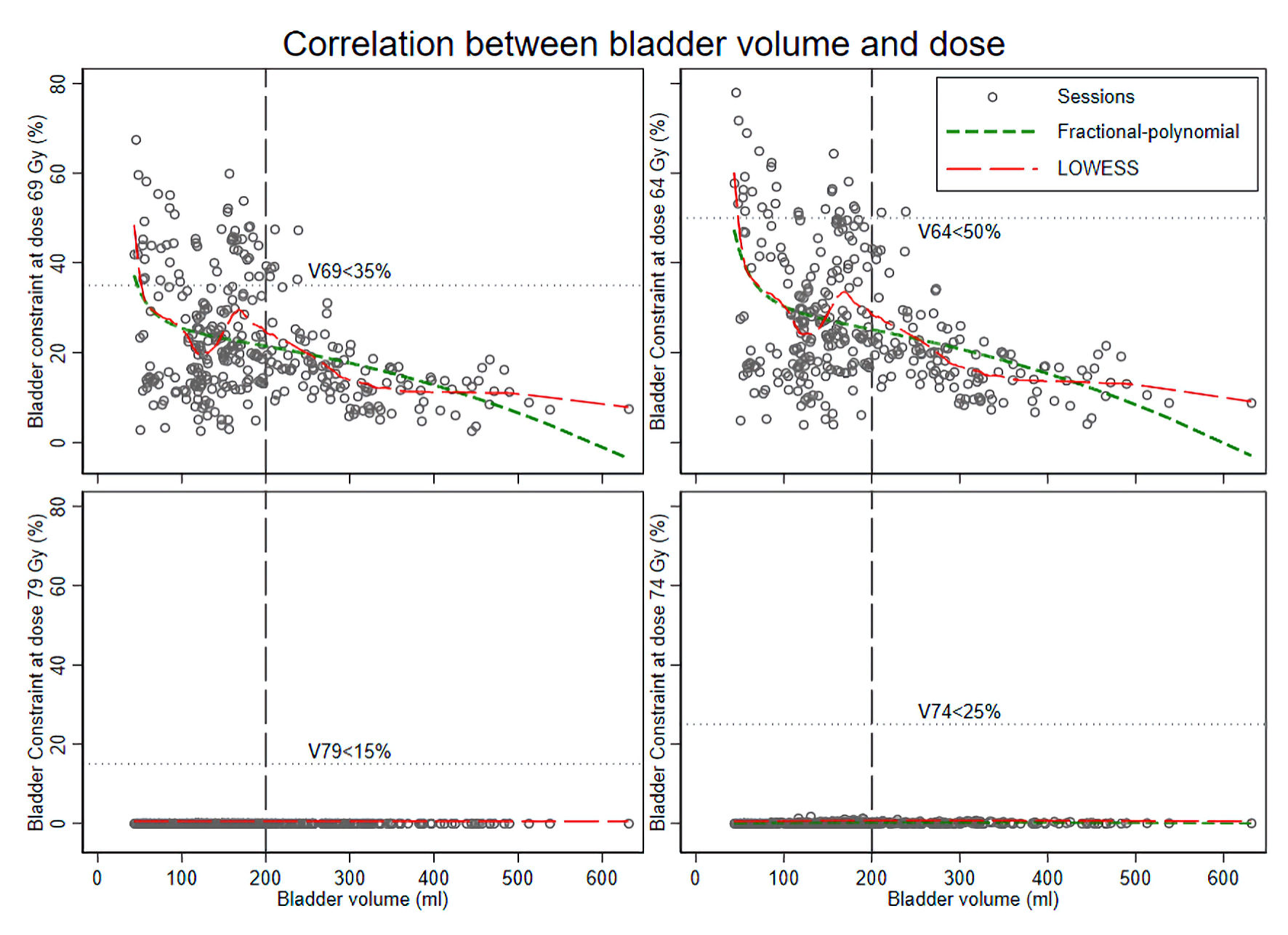
Background: The aim of the study was to evaluate the association between bladder volume and dose-volume constraints of organs at risk—specifically the bladder and rectum—in patients receiving moderately hypofractionated radiotherapy for localized prostate cancer, and to identify factors associated with exceeding organs-at-risk dose constraints.
Methods: This retrospective study included patients who received either 70 Gy in 28 fractions or 60 Gy in 20 fractions using volumetric modulated arc therapy with daily cone beam computed tomography. Bladder volume was measured at each session. Multilevel mixed-effects linear regression was used to assess the association between bladder volume and organs-at-risk dose constraints. Zero-inflated Poisson regression was applied to explore factors associated with organs-at-risk dose overdose, defined according to the Radiation Therapy Oncology Group (RTOG) 0415 and Conventional or Hypofractionated High Dose Intensity Modulated Radiotherapy in Prostate Cancer (CHHiP) trial thresholds.
Results: A total of 388 radiotherapy sessions were analyzed among 15 patients. Increased bladder volume was significantly associated with reduced radiation exposure to organs at risk. This protective effect was more pronounced for the urinary bladder (risk difference: −6.4% to −7.8% per 100 mL increase) than for the rectum (−1.0% to −2.2%) under the 70 Gy protocol. No significant rectal protection was observed under the 60 Gy protocol. The 60 Gy protocol (risk ratio = 15.4; 95% confidence interval, 2.93–81.02) and high recurrence risk (risk ratio = 2.41; 95% confidence interval, 1.12–5.16) were significant predictors of bladder overdose. The 60 Gy protocol was the only significant predictor of rectal overdose.
Conclusions: Larger bladder volumes reduce radiation exposure to organs at risk, particularly the urinary bladder. Rectal protection was limited, especially under the 60 Gy protocol. Optimizing bladder volume may improve treatment safety and adherence to dose constraints.
Published
Issue
Section
License
Copyright (c) 2026 The authors

This work is licensed under a Creative Commons Attribution 4.0 International License.