| World Journal of Nephrology and Urology, ISSN 1927-1239 print, 1927-1247 online, Open Access |
| Article copyright, the authors; Journal compilation copyright, World J Nephrol Urol and Elmer Press Inc |
| Journal website https://wjnu.elmerpub.com |
Original Article
Volume 15, Number 4, November 2026, pages 95-105

Beyond Paraquat: Acute Kidney Injury Following Non-Paraquat Poisoning
Saraswathi Yashaswinia, b  , Manjusha Yadlaa, Pathakala Srinivasa
aDepartment of Nephrology, Gandhi Medical College and Hospital, Hyderabad 500003, Telangana, India
bCorresponding Author: Saraswathi Yashaswini, Department of Nephrology, Gandhi Medical College and Hospital, Hyderabad 500003, Telangana, India
Manuscript submitted August 31, 2026, accepted October 5, 2026, published online November 18, 2026
Short title: AKI in Non-Paraquat Poisonings
doi: https://doi.org/10.14740/wjnu1074
| Abstract | ▴Top |
Background: Poisoning is a leading cause of acute kidney injury (AKI) referred to nephrology services in India. While AKI following paraquat ingestion is well characterized, patients poisoned with a heterogeneous range of non-paraquat agents also constitute a substantial referral burden, and their collective clinical and dialytic profile is less well described.
Methods: We conducted a retrospective, single-center case series of 20 consecutive patients with AKI following non-paraquat poisoning, referred to the Department of Nephrology, Gandhi Medical College and Hospital, Hyderabad, between June 2024 and May 2025. Demographic details, the causative agent, and the renal replacement therapy (RRT) modality instituted—peritoneal dialysis (PD), hemodialysis (HD), or continuous renal replacement therapy (CRRT)—were recorded for each patient.
Results: Twenty patients (11 men, nine women; age range 9–58 years; mean age 34.1 years) were identified. Nine distinct poisoning categories accounted for 20 patients: rodenticide (3% yellow phosphorus, n = 4), toddy adulterated with methanol (n = 2), corrosive acid (n = 2), Supervasmol hair dye/para-phenylenediamine (n = 4), methyl salicylate (oil of wintergreen) (n = 1), phenobarbitone (n = 1), glyphosate (n = 3), organophosphate compound (n = 2), and lithium (n = 1). PD was the most frequently used RRT modality.
Conclusion: Non-paraquat poisoning presenting with AKI in this tertiary nephrology unit was etiologically heterogeneous, spanning household, agricultural, and pharmaceutical agents, and required the full spectrum of renal replacement modalities. Awareness of this diverse case-mix, alongside the well-recognized paraquat and organophosphate poisonings, may help nephrology units anticipate resource needs and individualize dialytic strategy.
Keywords: Acute kidney injury; Poisoning; Peritoneal dialysis; Hemodialysis; Continuous renal replacement therapy; Para-phenylenediamine; Yellow phosphorus; Rodenticide
| Introduction | ▴Top |
Self-poisoning remains one of the commonest modes of self-harm in India and other low- and middle-income countries, and ingested poisons are a well-recognized precipitant of acute kidney injury (AKI) requiring nephrology input [1, 2]. Pesticides, herbicides, rodenticides, corrosives, and pharmaceutical agents taken with suicidal or accidental intent together contribute to a large share of poisoning-related hospital admissions in India, and a substantial proportion of these patients develop AKI severe enough to warrant renal replacement therapy (RRT). A recent hospital-based study from North India found that poisoning and envenomation accounted for a sizeable share of nephrology-referred AKI, with delayed presentation and hemodynamic compromise emerging as independent predictors of renal involvement [1], while a South Indian tertiary-center series similarly reported poisoning as a leading precipitant of community-acquired AKI [3]. Neither of these studies reported the specific proportion of overall AKI attributable to poisoning; however, a separate South Indian tertiary-center series found that drugs and poisons accounted for 12/102 (11.7%) of all AKI cases [4], indicating that poisoning is likely a modest but consistent contributor to the overall AKI burden in Indian tertiary centers.
Paraquat poisoning has attracted disproportionate clinical and research attention because of its near-uniform lethality and its characteristic multi-organ, including renal, toxicity. However, paraquat is only one of a very wide array of agents encountered in nephrology practice [1, 2], and the non-paraquat poisonings—ranging from household rodenticides and hair dyes to agricultural herbicides, corrosives, and sedative overdoses—are individually less common but collectively account for a sizeable share of poisoning-associated AKI. Early series from Indian tertiary centers reported barbiturates, copper sulphate, and organophosphates (OPs) among the agents most commonly necessitating dialysis [5], a case-mix that has since diversified further with the emergence of newer household and agricultural toxins. A more recent analysis of acute poisoning presentations at a North Indian tertiary hospital likewise documented a broad and evolving spectrum of implicated agents, reinforcing that the toxicological landscape relevant to nephrology referral is not static [6].
Documenting the spectrum, demographic pattern, and dialysis requirements of such non-paraquat poisonings referred to a nephrology department is relevant for two reasons. First, it highlights agents that are less classically taught but are locally prevalent because of easy availability (e.g., yellow-phosphorus-containing rodenticide paste, para-phenylenediamine-containing hair dye, and methanol-adulterated toddy). Renal injury from these agents arises through diverse and often overlapping mechanisms—direct tubular toxicity, rhabdomyolysis and intravascular hemolysis with pigment nephropathy, hypovolemia/hypoperfusion, and hepatorenal dysfunction—each carrying distinct implications for clinical monitoring and choice of renal replacement modality [6–30]. Second, it informs preparedness for the range of RRT modalities—peritoneal dialysis (PD), intermittent hemodialysis (HD), and continuous renal replacement therapy (CRRT)—that a nephrology unit must be able to deploy for poisoning-associated AKI, since the modality of choice often depends on hemodynamic stability, toxin dialysability, and resource availability rather than on the poison alone.
Despite this diversity, data specifically characterizing the spectrum, clinical course, and renal replacement patterns of non-paraquat poisoning presenting to nephrology services from South India remain limited, with most existing literature either focused on paraquat alone or reporting poisoning-related AKI as a pooled, undifferentiated category [1–3]. We therefore describe a case series of 20 patients with AKI following non-paraquat poisoning, spanning nine distinct identifiable toxic categories in addition to a substantial proportion of unidentified agents, who were referred to and managed by the Department of Nephrology at a tertiary care teaching hospital in South India, and we discuss the agent-specific mechanisms of renal injury and the RRT patterns observed in this cohort.
| Materials and Methods | ▴Top |
Study design and setting
This was a retrospective, descriptive case series conducted in the Department of Nephrology, Gandhi Medical College and Hospital, Hyderabad, Telangana, a tertiary care teaching institution that receives poisoning referrals from the emergency medicine and general medicine departments as well as from peripheral centers.
A total of 86 patients were referred to Nephrology, of whom 20 patients required RRT and 66 patients were managed conservatively.
The study period spanned June 2024 through May 2025.
Clinical management and outcomes
Among the 86 patients referred to the Department of Nephrology, 20 patients (23.3%) required RRT, while 66 patients (76.7%) were managed conservatively with appropriate supportive and medical management. Data regarding demographic characteristics, nature of poisoning, renal function, requirement and modality of RRT, hospital outcome, and follow-up renal status were collected from hospital and departmental records.
The primary outcome was complete renal recovery.
Secondary outcomes included all-cause mortality, requirement for RRT, and progression to chronic kidney disease (CKD) during follow-up.
Definitions
Complete renal recovery was defined as recovery of renal function without evidence of persistent kidney dysfunction at follow-up, based on available clinical and laboratory records. Progression to CKD was recorded when persistent renal dysfunction fulfilling criteria for CKD was documented during follow-up.
Case ascertainment
Consecutive patients referred to the nephrology department with AKI in the setting of an alleged history of poison ingestion were identified from referral records. Patients with a confirmed history of paraquat ingestion were excluded, as these have been analyzed separately.
Data variables
For each patient, the following were recorded: age, sex, the poison or poison category implicated, the date of referral to nephrology, and the RRT modality instituted (PD, HD, CRRT, or a combination).
Study outcomes
Primary outcome
The primary outcome of the study was complete renal recovery following an episode of KDIGO stage 3 AKI associated with non-paraquat poisoning.
Secondary outcomes
The secondary outcomes of the study included: (1) mortality—death during the acute hospitalization or during the available follow-up period; and (2) progression to CKD—persistent renal dysfunction progressing to CKD during follow-up.
Statistical analysis
Data are presented descriptively as counts, percentages, means, and ranges, given the small sample size and case-series design.
Ethical considerations
This study was approved by the Institutional Ethics Committee. Given its retrospective, de-identified nature, the requirement for individual informed consent was waived. Patient identifiers have been removed and each case is referred to by a serial number in this report.
| Results | ▴Top |
A total of 20 patients with non-paraquat poisoning-associated AKI requiring RRT were included in the analysis. These patients presented to the hospital between June 2024 and May 2025. The mean age of the study population was 35.6 ± 12.8 years, with an age range of 9–58 years. Males constituted a slight majority of the cohort (55%), while females accounted for 45%. Diabetes mellitus and hypertension were present in 20% and 25% of patients, respectively, whereas only one patient (5%) had documented pre-existing CKD. The mean urine output at presentation was 560 mL, with considerable inter-individual variation (100–1,500 mL) (Table 1).
 Click to view | Table 1. Baseline Demographic and Clinical Characteristics (N = 20) |
The baseline laboratory profile demonstrated substantial biochemical abnormalities. The mean hemoglobin concentration was 9.9 ± 1.5 g/dL, while the mean total leucocyte count was 13,922 ± 7,091/µL. The mean admission serum creatinine was 2.13 ± 1.29 mg/dL and increased to 5.87 ± 2.08 mg/dL at nephrology referral or initiation of RRT. Electrolyte abnormalities were frequent, with a mean serum sodium of 131.8 ± 7.9 mEq/L. Liver biochemical parameters were also abnormal, with elevated mean bilirubin, alanine aminotransferase (ALT), and aspartate aminotransferase (AST) levels. The mean serum albumin was 3.53 ± 0.82 g/dL, indicating that hypoalbuminemia was present in a substantial proportion of patients (Table 2).
Click to view | Table 2. Baseline Biochemical and Laboratory Parameters at Presentation (N = 20) |
The etiological spectrum of poisoning was heterogeneous. Rodenticide exposure and para-phenylenediamine (PPD)-containing hair-dye poisoning were each observed in four patients (20%), followed by glyphosate poisoning in three patients (15%). Methanol-adulterated toddy, corrosive acid ingestion, and OP poisoning accounted for two patients each (10%), while lithium, phenobarbitone, and methyl salicylate poisoning were each identified in one patient (5%) (Table 3).
Click to view | Table 3. Category-Wise Distribution of Non-Paraquat Poisoning-Associated AKI (N = 20) |
PD was the most frequently used renal replacement modality in this cohort, either as monotherapy or in combination with HD and/or CRRT. The requirement for combined modalities in several patients reflects the severity and multisystem nature of poisoning-associated illness. Patient-level characteristics and the corresponding toxic agent and RRT modality are presented in Table 4.
Click to view | Table 4. Patient-Level Summary (N = 20) |
Overall in-hospital mortality was high: 15 of 20 patients (75%) died, while only five patients (25%) survived to hospital discharge. Mortality was particularly high among patients requiring more than one RRT modality, although these findings should be interpreted cautiously because of the very small numbers in each subgroup. Marked variation in mortality was also observed across poisoning categories. All patients with PPD-containing hair-dye poisoning, corrosive acid ingestion, lithium poisoning, phenobarbitone poisoning, and methyl salicylate poisoning died. Mortality was also substantial among patients with yellow-phosphorus rodenticide and glyphosate exposure. In contrast, none of the patients with methanol-adulterated toddy died in the present dataset. These category-specific estimates should be interpreted with caution because several categories contained only one or two patients (Table 5).
Click to view | Table 5. In-Hospital Mortality, Overall and by RRT Modality and Poisoning Category |
Among the five patients who survived to hospital discharge, two (40%) had stable renal function or recovery at follow-up, whereas three (60%) developed or progressed to CKD. Consequently, only 10% of the entire cohort achieved stable renal recovery, while 15% progressed to CKD. Overall, the findings demonstrate that survival from severe poisoning-associated AKI did not necessarily result in complete renal recovery and that a substantial proportion of survivors had persistent renal impairment (Table 6).
Click to view | Table 6. Renal Recovery Status Among Survivors to Discharge (n = 5) |
Hematological and biochemical abnormalities were common at presentation. Anemia was the most frequent abnormality, affecting 75% of patients, followed by hyponatremia in 70% and elevated admission serum creatinine in 65%. Elevated ALT and AST levels were each observed in 60% of patients, while leucocytosis, hyperbilirubinemia, and elevated alkaline phosphatase (ALP) were each present in approximately half of the cohort. Hypokalemia occurred in 45%, hypoalbuminemia in 40%, thrombocytopenia in 30%, and hyperkalemia in 10%. The coexistence of renal, hepatic, electrolyte, and hematological abnormalities suggests that these patients frequently had multisystem involvement rather than isolated kidney injury (Table 7).
Click to view | Table 7. Prevalence of Biochemical and Hematological Abnormalities at Presentation (N = 20) |
Comparison of survivors and non-survivors among patients requiring RRT
Among the 20 patients with non-paraquat poisoning-associated AKI who required RRT, five (25%) survived and 15 (75%) died. Survivors and non-survivors were comparable with respect to age, sex, baseline renal function, severity of renal dysfunction at nephrology referral, urine output, and duration of PD. The median age was 34 years (interquartile range (IQR), 30–38) among survivors and 41 years (IQR, 23–45) among non-survivors (P = 1.000). Males constituted 80% of survivors compared with 46.7% of non-survivors (P = 0.319).
When survivors and non-survivors were compared, demographic characteristics and baseline renal parameters did not differ significantly. The median age was 34 years among survivors and 41 years among non-survivors (P = 1.000). Similarly, admission creatinine and creatinine at nephrology referral/RRT initiation were not significantly different between the two groups.
In contrast, markers of systemic severity demonstrated clear differences. Pre-RRT urine output was significantly higher among survivors than non-survivors (median 800 vs. 300 mL; P = 0.01). Survivors also had significantly lower quick Sequential Organ Failure Assessment (qSOFA) scores (1.1 ± 0.6 vs. 2.1 ± 0.8; P = 0.001), suggesting lower physiological severity at presentation. The requirement for inotropic support was substantially lower among survivors (20% vs. 55%, P < 0.001), and ventilator requirement was also lower among survivors (34% vs. 76%, P < 0.001). In contrast, duration of PD and measured serum biochemical parameters, including sodium, potassium, bilirubin, ALT, AST, ALP, and albumin, did not show statistically significant differences between the groups (Table 8).
Click to view | Table 8. Comparison of Survivors and Non-Survivors Among Patients Requiring RRT |
Overall, these findings suggest that systemic illness severity and preserved urine output, rather than the absolute degree of azotemia alone, were more closely associated with survival in this small cohort of patients with non-paraquat poisoning-associated AKI requiring RRT.
It is also informative to consider the 66 patients who were managed conservatively without RRT, since Figure 1 captures only their aggregate outcome. Among these patients, the causative agents were Supervasmol (PPD-containing hair dye) in 18, OP compounds in 13, rodenticide (yellow phosphorus) in 12, glyphosate in eight, methanol-adulterated toddy in six, phenytoin overdose in one, and an unidentified agent in eight. This distribution broadly mirrors the categories represented in the RRT-requiring cohort, indicating that most patients exposed to these agents developed AKI severe enough to warrant nephrology referral but not RRT, and that progression to dialysis-requiring AKI is a minority, agent-nonspecific outcome within this poisoning-related referral population.
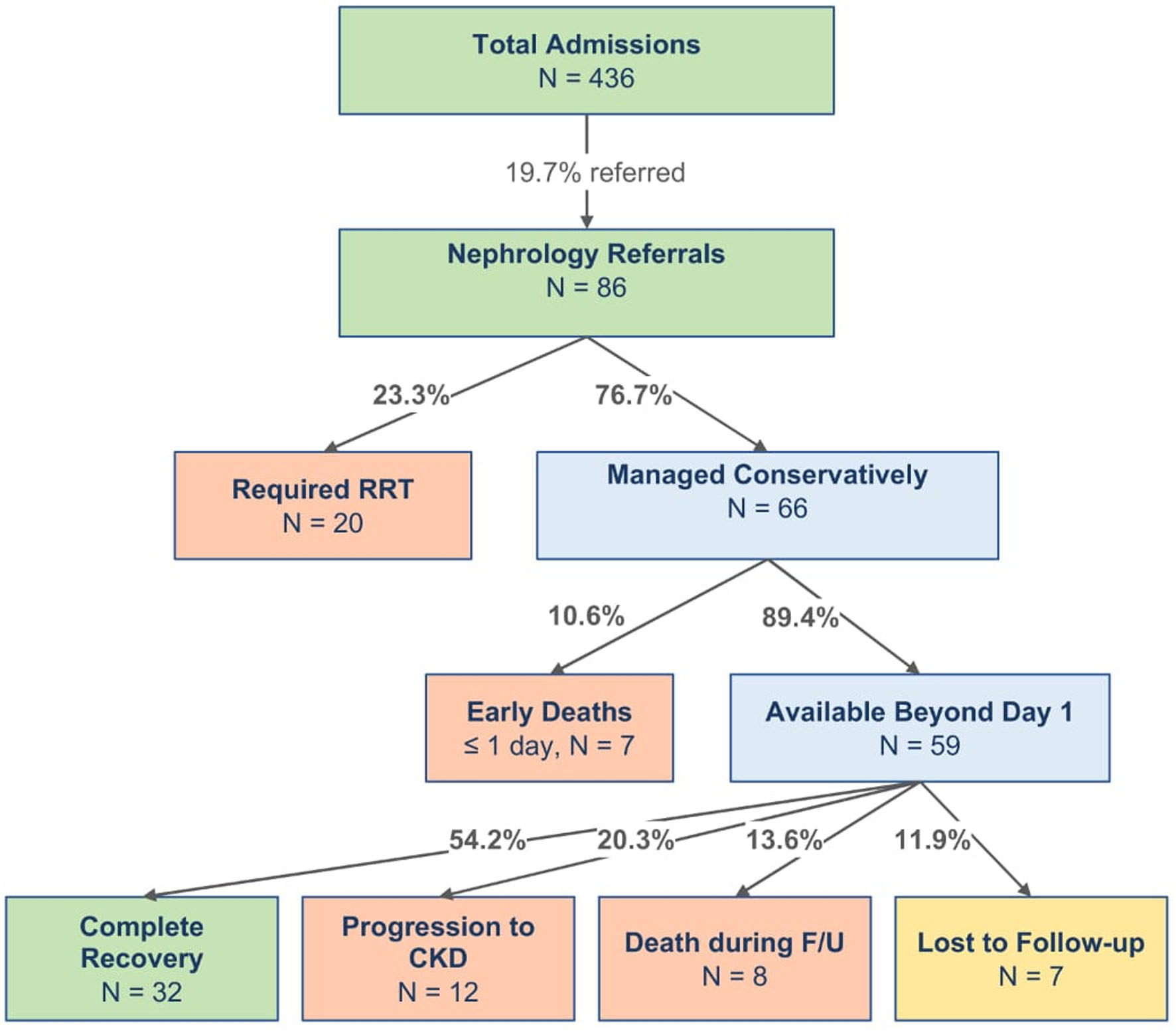 Click for large image | Figure 1. Flowchart of total non-paraquat poisonings outcomes. |
| Discussion | ▴Top |
This case series illustrates the etiological diversity of non-paraquat poisoning-associated AKI encountered in routine nephrology referral practice at a South Indian tertiary center, spanning household rodenticides, cosmetic and industrial chemicals, agricultural herbicides, corrosives, and pharmaceutical overdoses, and adds agent-specific granularity to the broader epidemiological picture reported from Indian tertiary centers, where poisoning remains among the leading causes of hospital- and community-acquired AKI [1, 3, 6]. We discuss the renal implications of each represented category below.
Rodenticide (yellow phosphorus) poisoning
Yellow-phosphorus-containing rodenticide pastes (commonly marketed as Ratol, containing approximately 3% elemental phosphorus) remain a common and highly lethal self-poisoning agent in India [5, 7]. Yellow phosphorus is rapidly absorbed from the gastrointestinal tract and is predominantly hepatotoxic, but is also distributed to the kidney, heart, and pancreas, and can independently produce acute tubular injury superimposed on the hemodynamic and coagulopathic derangements of acute liver failure [7, 8], a pattern well described in South Indian case series where AKI typically emerges during the fulminant hepatic-failure phase of the classic tri-phasic course [8]. Both patients with rodenticide poisoning in our series were managed with PD, consistent with reports that AKI in this setting often accompanies multi-organ dysfunction requiring supportive renal replacement rather than toxin-specific extracorporeal removal, since no antidote or effective extracorporeal elimination technique exists for phosphorus itself [5, 7, 8]. Close monitoring of hepatic synthetic function alongside renal parameters is therefore essential in this group [9].
Methanol-adulterated toddy
Illicit and traditionally fermented alcoholic beverages such as toddy are periodically adulterated with methanol to increase potency or reduce cost, precipitating mass poisoning outbreaks (“hooch tragedies”) across India [10]. Methanol is metabolized to formaldehyde and then formic acid, producing severe high-anion-gap metabolic acidosis, optic neuropathy, and, less classically, AKI, which has been reported in a substantial minority of methanol-poisoned patients and is associated with lower admission pH and higher formate levels [11, 12].
Corrosive acid ingestion
Corrosive ingestion, whether accidental or suicidal, remains common in India because of the ready availability of concentrated acids and alkalis [13]. Beyond the well-known esophagogastric injury, systemic absorption and the associated hypovolemia, hemolysis, and direct tubular toxicity can independently precipitate AKI, which has been reported as a complication in a meaningful minority of severe corrosive ingestions [13]. Our patient with acid ingestion was managed with PD; the choice of PD over HD in corrosive-related AKI is due to hemodynamic instability and the difficulty of vascular access in patient.
Supervasmol (PPD) hair dye poisoning
PPD-containing hair dyes, marketed in India under brand names such as Supervasmol, are ingested with suicidal intent with alarming frequency because of their low cost and easy availability [14, 18]. PPD produces a characteristic triad of angioneurotic edema of the face and neck (occasionally necessitating emergency tracheostomy), rhabdomyolysis, and intravascular hemolysis, culminating in AKI through pigment-cast nephropathy and acute tubular necrosis through both immune-mediated and direct cytotoxic mechanisms [14–17]; AKI has been reported in up to a third of hospitalized PPD-poisoning cases in Indian and Pakistani series [14, 18]. This was the largest single named category in our series (four patients), managed with a mix of PD and HD. Airway compromise, rather than renal failure per se, is the earliest life-threatening feature of PPD poisoning; early HD is traditionally favored when angioedema and hyperkalemia coexist, whereas PD remains a reasonable option once airway compromise has been excluded.
Phenobarbitone overdose
Barbiturate overdose, though less common than in earlier decades, continues to be encountered and was historically the single commonest indication for dialysis in acute poisoning in some Indian series [5]. Phenobarbitone-induced AKI most often arises from rhabdomyolysis secondary to prolonged coma-related immobilization rather than direct nephrotoxicity. Because phenobarbital has a low pKa and high water solubility, it is efficiently cleared by intermittent HD, which the Extracorporeal Treatments in Poisoning (EXTRIP) Workgroup recommends for patients with prolonged coma, respiratory depression, shock, or persistently elevated barbiturate levels [30]. Our patient was, however, managed with CRRT, which may have been selected because of hemodynamic instability precluding intermittent HD.
Glyphosate (herbicide) poisoning
Glyphosate-based herbicides are widely used in Indian agriculture and are generally regarded as having a favorable safety margin, but large ingested doses can cause corrosive gastrointestinal injury, cardiotoxicity, and AKI, occasionally requiring HD or CRRT [19, 20]. Contemporary toxicological analyses attribute much of this cytotoxicity and cardiovascular collapse to the polyoxyethyleneamine (POEA) surfactant component of the formulation rather than to glyphosate itself [19], and larger cohort data indicate that supportive care and hydration alone are sufficient in most patients, with RRT reserved for a minority with severe toxicity [19, 21]. The mechanism of renal injury is not fully elucidated but has been attributed variously to acute tubular necrosis and, in at least one reported case, biopsy-proven acute tubulointerstitial nephritis responsive to corticosteroid therapy [22].
OP poisoning
OP compounds remain the most common agricultural poison encountered in Indian emergency departments, chiefly through cholinesterase inhibition producing a cholinergic toxidrome [23]. AKI is a comparatively uncommon but increasingly recognized complication, with proposed mechanisms including direct tubular oxidative injury, rhabdomyolysis, and renal hypoperfusion from vomiting-induced volume depletion [25]; isolated case reports of AKI requiring HD after OP poisoning support the plausibility of this pattern in a minority of severe cases [26], and a broader mechanistic review has similarly implicated direct oxidative tubular injury alongside pre-renal factors [25]. Our patient with OP poisoning-associated AKI was managed with PD alongside standard atropine/oxime therapy.
Methyl salicylate poisoning
Methyl salicylate (oil of wintergreen) is a concentrated source of salicylate that is disproportionately toxic relative to its small ingested volume. Salicylates uncouple oxidative phosphorylation, producing a mixed respiratory alkalosis/metabolic acidosis, and are directly nephrotoxic, with AKI reported in roughly 1 in 10 hospitalized salicylate-intoxication admissions and associated with pre-existing renal impairment and hemodynamic instability [27]. HD, which was used in our patient, is the treatment of choice for severe salicylate toxicity because it corrects acidosis while efficiently clearing the drug [28, 29].
Lithium poisoning
Lithium poisoning can cause severe neurological and systemic toxicity, particularly when renal clearance is impaired. Because lithium is minimally protein-bound and predominantly renally excreted, HD is the preferred extracorporeal treatment in severe toxicity, while CRRT may be used when hemodynamic instability limits intermittent HD. EXTRIP recommendations emphasize that the decision for extracorporeal treatment should consider clinical toxicity, renal function, and serial lithium concentrations, rather than serum lithium level alone.
In our study, one patient with lithium-associated AKI required PD, HD, and CRRT and subsequently died. This finding highlights the potential severity of lithium poisoning with AKI; however, because only one patient was involved, the observed mortality should be interpreted descriptively rather than as evidence of a specific mortality risk.
The principal finding of this study is that severe AKI following non-paraquat poisoning represents a clinically heterogeneous but high-risk syndrome with substantial mortality and an important long-term renal burden. Almost one-fifth of all non-paraquat poisoning admissions developed KDIGO stage 3 AKI requiring nephrology referral, and nearly one-quarter of these patients required RRT. The diversity of toxic agents, together with frequent hepatic, hematological, electrolyte, and hemodynamic abnormalities, indicates that poisoning-associated AKI should be viewed as a manifestation of systemic toxic illness rather than isolated renal injury.
The outcome gradient according to RRT requirement is particularly striking. Patients requiring RRT had a 75% in-hospital mortality, compared with 22.7% among those managed conservatively. This difference should not be interpreted as evidence that RRT itself increases mortality; rather, the need for RRT is a marker of greater underlying illness severity and multisystem organ dysfunction. Within the RRT group, higher urine output and lower qSOFA scores were associated with survival, while the need for vasopressor and ventilatory support was substantially more frequent among non-survivors. Importantly, serum creatinine at presentation or at RRT initiation did not discriminate survivors from non-survivors, reinforcing the limitations of using creatinine alone to assess prognosis in acute toxic illness.
Renal recovery among survivors was also incomplete. Only two of five RRT survivors (40%) had stable renal function or recovery at follow-up, whereas three (60%) progressed to CKD. Similarly, among conservatively managed patients available for follow-up, approximately one-fifth developed CKD. These findings emphasize that hospital survival is not synonymous with renal recovery and support systematic post-discharge monitoring of renal function after severe poisoning-associated AKI.
Dialyzability of the implicated agents
Drug levels were not measured for any agent in this series, and none were re-checked after RRT, reflecting resource constraints typical of a government tertiary-care setting; RRT was instituted for AKI and its systemic complications rather than for toxin removal per se. Based on published toxicokinetic data, the agents in this cohort differ substantially in their amenability to extracorporeal removal, summarized in Table 9.
Click to view | Table 9. Dialyzability of the Implicated Agents Based on Published Toxicokinetic Data |
Limitations
This series has the inherent limitations of a small, single-center, retrospective case series without a comparison group. The causative agent could not be confirmed by laboratory toxicological analysis in most cases and relied on history alone.
Conclusion
Non-paraquat poisoning is an important, under-recognized cause of severe AKI in tertiary nephrology practice and has diverse etiology encompassing at least nine distinct identifiable agent categories—most frequently Supervasmol (hair-dye/PPD) and yellow-phosphorus rodenticide. Continued documentation of such locally prevalent, non-paraquat poisonings—alongside the extensively studied paraquat and OP poisonings—may help nephrology services anticipate case-mix and dialytic resource requirements in similar tertiary care settings.
Acknowledgments
None to declare.
Financial Disclosure
This study received no specific grant from any funding agency in the public, commercial, or not-for-profit sectors.
Conflict of Interest
The authors declare no conflict of interest.
Informed Consent
Informed consent was waived by IEC because of retrospective and anonymized data.
Author Contributions
SY contributed to the study design, collected the data from hospital records, performed the data analysis, and wrote the original draft of the manuscript. MY contributed to the study conception and supervision, was involved in the clinical management of patients, and critically revised the manuscript. PS was involved in the clinical management of patients, contributed to the literature search and data interpretation, and critically revised the manuscript. All authors read and approved the final version of the manuscript.
Data Availability
Data supporting this case report are available from the corresponding author upon reasonable request.
| References | ▴Top |
- Khan A, Quaiser S, Khan R, Agrawal N. Poisoning and envenomation induced acute kidney injury: a hospital-based study. Indian J Nephrol. 2025;35(2):283-289.
doi pubmed - Naqvi R. Acute kidney injury from different poisonous substances. World J Nephrol. 2017;6(3):162-167.
doi pubmed - Priyashree R, Shyamsundar CM, Kumar NS. Clinical profile and prognosis of patients with acute kidney injury from a tertiary care hospital in south India. J Med Sci Res. 2022;10(1):16-19.
doi - Santhanam J, Subramaniyan Natarajan M, Lakshmanan A, Balakrishnan RK. Pattern of acute kidney injury and its outcome in a tertiary care centre. Int J Res Med Sci. 2020;8(2).
doi - Agarwal SK, Tiwari SC, Dash SC. Spectrum of poisoning requiring haemodialysis in a tertiary care hospital in India. Int J Artif Organs. 1993;16(1):20-22.
pubmed - Aggarwal N, Sawlani KK, Chaudhary SC, Usman K, Dandu H, Atam V, Rani S, et al. Study of pattern and outcome of acute poisoning cases at tertiary care hospital in North India. J Family Med Prim Care. 2023;12(9):2047-2052.
doi pubmed - Rasheed A, Acharya S, Shukla S. Case report: yellow phosphorus induced acute fulminant hepatitis and acute kidney injury in a male. SSRG Int J Med Sci. 2018;5(11):1-2.
- Mishra AK, Devakiruba NS, Jasmine S, Sathyendra S, Zachariah A, Iyadurai R. Clinical spectrum of yellow phosphorous poisoning in a tertiary care centre in South India: a case series. Trop Doct. 2017;47(3):245-249.
doi pubmed - Angraje S, Sekar M, Mishra B, Matcha J. Outcome of Plasma Exchange in Acute Liver Failure due to Yellow Phosphorus Poisoning: A Single-center Experience. Indian J Crit Care Med. 2021;25(9):1020-1025.
doi pubmed - Francis ST, Nair JR, Shiji PV, Mohamed S, Geetha P. A case series of acute methanol poisoning from northern Kerala. Emergency Med. 2016;6:312.
- Kraut JA, Mullins ME. Toxic alcohols. N Engl J Med. 2018;378(3):270-280.
doi pubmed - Verhelst D, Moulin P, Haufroid V, Wittebole X, Jadoul M, Hantson P. Acute renal injury following methanol poisoning: analysis of a case series. Int J Toxicol. 2004;23(4):267-273.
doi pubmed - Hall AH, Jacquemin D, Henny D, Mathieu L, Josset P, Meyer B. Corrosive substances ingestion: a review. Crit Rev Toxicol. 2019;49(8):637-669.
doi pubmed - Naqvi R, Akhtar F, Farooq U, Ashraf S, Rizvi SA. From diamonds to black stone; myth to reality: Acute kidney injury with paraphenylene diamine poisoning. Nephrology (Carlton). 2015;20(12):887-891.
doi pubmed - Anuradha S, Arora S, Mehrotra S, Arora A, Kar P. Acute renal failure following para-phenylenediamine (PPD) poisoning: a case report and review. Ren Fail. 2004;26(3):329-332.
doi pubmed - Averbukh Z, Modai D, Leonov Y, Weissgarten J, Lewinsohn G, Fucs L, Golik A, et al. Rhabdomyolysis and acute renal failure induced by paraphenylenediamine. Hum Toxicol. 1989;8(5):345-348.
doi pubmed - Dinis-Oliveira RJ, Carvalho F, Moreira R, Proença JB, Santos A. Clinical and forensic aspects of para-phenylenediamine poisoning. Clin Toxicol (Phila). 2008;46(8):658-669.
- Asghar S, Mahbub S, Asghar S, Shahid S. Paraphenylenediamine (Hair Dye) poisoning: a prospective study on the clinical outcome and side effects profile. Cureus. 2022;14(9):e29133.
doi pubmed - Sampogna RV, Cunard R. Roundup intoxication and a rationale for treatment. Clin Nephrol. 2007;68(3):190-196.
doi pubmed - Talbot AR, Shiaw MH, Huang JS, Yang SF, Goo TS, Wang SH, Chen CL, et al. Acute poisoning with a glyphosate-surfactant herbicide ('Roundup'): a review of 93 cases. Hum Exp Toxicol. 1991;10(1):1-8.
doi pubmed - Cho AY, Oh JH, Oh SS, Lee KY, Sun IO. Clinical characteristics of acute kidney injury in patients with glyphosate surfactant herbicide poisoning. Kidney Res Clin Pract. 2023;42(3):349-357.
doi pubmed - Omote D, Makino SI, Okunaga I, Ishii M, Tatsumoto N, Aizawa M, Asanuma K. Unusual course of glyphosate-induced acute kidney injury: a case report of tubulointerstitial nephritis treated with steroids. CEN Case Rep. 2025;14(2):128-134.
doi pubmed - Eddleston M, Buckley NA, Eyer P, Dawson AH. Management of acute organophosphorus pesticide poisoning. Lancet. 2008;371(9612):597-607.
doi pubmed - Peter JV, Sudarsan TI, Moran JL. Clinical features of organophosphate poisoning: A review of different classification systems and approaches. Indian J Crit Care Med. 2014;18(11):735-745.
doi pubmed - Sobolev VE, Sokolova MO, Jenkins RO, Goncharov NV. Molecular mechanisms of acute organophosphate nephrotoxicity. Int J Mol Sci. 2022;23(16):8855.
doi pubmed - Zafar R, Munawar K, Nasrullah A, Haq S, Ghazanfar H, Sheikh AB, Khan AY. Acute renal failure due to organophosphate poisoning: a case report. Cureus. 2017;9(7):e1523.
doi pubmed - Thongprayoon C, Petnak T, Kaewput W, Qureshi F, Mao MA, Pivovarova AI, Boonpheng B, et al. Acute kidney injury among salicylate intoxication hospitalisations in the United States. Int J Clin Pract. 2021;75(3):e13745.
doi pubmed - Higgins RM, Connolly JO, Hendry BM. Alkalinization and hemodialysis in severe salicylate poisoning: comparison of elimination techniques in the same patient. Clin Nephrol. 1998;50(3):178-183.
pubmed - Dargan PI, Wallace CI, Jones AL. An evidence based flowchart to guide the management of acute salicylate (aspirin) overdose. Emerg Med J. 2002;19(3):206-209.
doi pubmed - Mactier R, Laliberte M, Mardini J, Ghannoum M, Lavergne V, Gosselin S, Hoffman RS, et al. Extracorporeal treatment for barbiturate poisoning: recommendations from the EXTRIP Workgroup. Am J Kidney Dis. 2014;64(3):347-358.
doi pubmed
This article is distributed under the terms of the Creative Commons Attribution 4.0 International License (CC BY 4.0), which permits unrestricted use, distribution, and reproduction in any medium, including commercial use, provided the original work is properly cited.
World Journal of Nephrology and Urology is published by Elmer Press Inc.