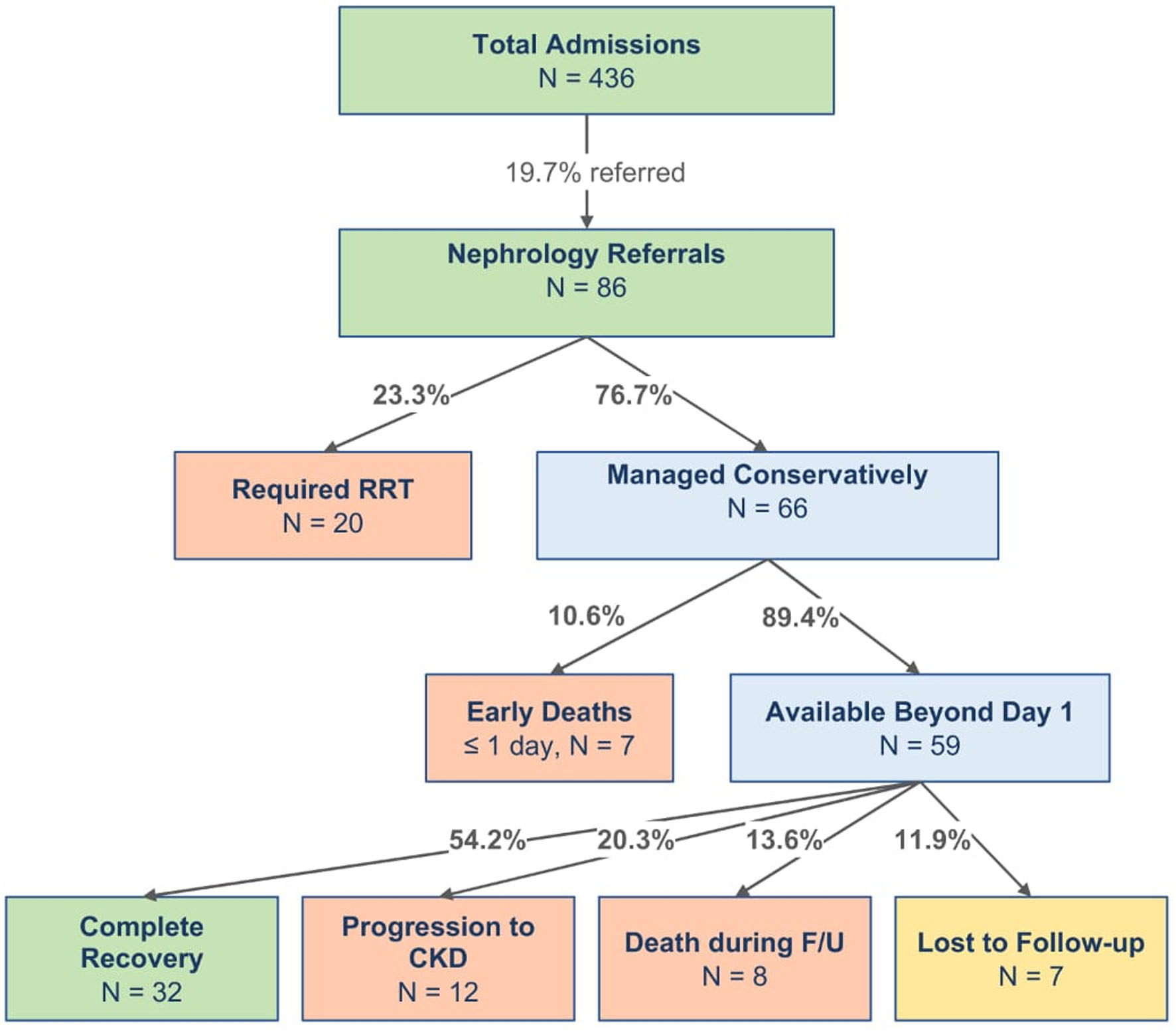
↓ Figure 1. Flowchart of total non-paraquat poisonings outcomes.
| World Journal of Nephrology and Urology, ISSN 1927-1239 print, 1927-1247 online, Open Access |
| Article copyright, the authors; Journal compilation copyright, World J Nephrol Urol and Elmer Press Inc |
| Journal website https://wjnu.elmerpub.com |
Original Article
Volume 15, Number 4, November 2026, pages 95-105
Beyond Paraquat: Acute Kidney Injury Following Non-Paraquat Poisoning
Figure
Tables
| Parameter | Value | Percentage/range |
|---|---|---|
| aDocumented history of CKD before the poisoning episode. bMean urine output (mL) recorded before initiation of RRT; the range is given in the last column. CKD: chronic kidney disease; RRT: renal replacement therapy; SD: standard deviation. | ||
| Total patients (N) | 20 | 100% |
| Age, mean ± SD (range), years | 35.6 ± 12.8 | 9–58 |
| Sex | ||
| Male | 11 | 55.0% |
| Female | 9 | 45.0% |
| Type 2 diabetes mellitus | 4 | 20.0% |
| Hypertension | 5 | 25.0% |
| Known pre-existing CKDa | 1 | 5.0% |
| Pre-RRT urine output mean (mL)b | 560 | 100–1,500 |
| Parameter | Mean ± SD | Range |
|---|---|---|
| aSerum creatinine measured at hospital admission, before nephrology referral. Values are mean ± standard deviation (SD). ALP: alkaline phosphatase; ALT: alanine aminotransferase; AST: aspartate aminotransferase; RRT: renal replacement therapy; SD: standard deviation. | ||
| Hemoglobin (g/dL) | 9.9 ± 1.5 | 8.0–14.3 |
| Total leucocyte count (/µL) | 13,922 ± 7,091 | 4,000–24,600 |
| Platelet count (× 103/µL) | 208 ± 108 | 98–481 |
| Admission serum creatinine (mg/dL)a | 2.13 ± 1.29 | 0.60–4.10 |
| Referral/RRT-initiation creatinine (mg/dL) | 5.87 ± 2.08 | 1.90–11.0 |
| Serum sodium (mEq/L) | 131.8 ± 7.9 | 120–145 |
| Serum potassium (mEq/L) | 3.79 ± 0.81 | 2.90–5.80 |
| Total bilirubin (mg/dL) | 3.42 ± 0.69 | 0.70–4.10 |
| ALT (U/L) | 167.5 ± 49.6 | 24–186 |
| AST (U/L) | 175 ± 56 | 27–210 |
| ALP (U/L) | 132.7 ± 41.4 | 88–225 |
| Serum albumin (g/dL) | 3.53 ± 0.82 | 1.60–5.20 |
| Poisoning category | n (%) | RRT modality, n |
|---|---|---|
| AKI: acute kidney injury; CRRT: continuous renal replacement therapy; HD: hemodialysis; PD: peritoneal dialysis. | ||
| Rodenticide (3% yellow phosphorus) | 4 (20%) | PD (2) |
| Toddy adulterated with methanol | 2 (10%) | PD (1), PD + HD + CRRT (1) |
| Corrosive acid ingestion | 2 (10%) | PD (1), PD + CRRT (1) |
| Lithium | 1 (5%) | PD + HD + CRRT |
| Supervasmol (PPD-containing hair dye) | 4 (20%) | PD (2), PD + CRRT (2) |
| Phenobarbitone overdose | 1 (5%) | CRRT (1) |
| Glyphosate (herbicide) | 3 (15%) | CRRT (1), PD (1), PD + CRRT (1) |
| Organophosphate compound | 2 (10%) | PD + HD (2) |
| Methyl salicylate | 1 (5%) | HD + CRRT |
| Total | 20 (100) | PD (20), HD (5), CRRT (9), combined (10) |
| S. No. | Age/sex | Category | Agent consumed | RRT modality |
|---|---|---|---|---|
| CRRT: continuous renal replacement therapy; HD: hemodialysis; OP: organophosphate; PD: peritoneal dialysis; PPD: para-phenylenediamine. | ||||
| 1 | 44/M | Heavy metal | Lithium | PD |
| 2 | 34/M | Rodenticide | Yellow phosphorus (3%) | PD |
| 3 | 30/F | Methanol | Toddy adulterated with methanol | PD |
| 4 | 28/F | Corrosive | Acid | PD |
| 5 | 50/M | Methanol | Toddy adulterated with methanol | PD |
| 6 | 41/M | PPD poisoning | Supervasmol (hair dye) | HD |
| 7 | 20/F | Corrosive | Acid | HD |
| 8 | 20/F | Phenobarbitone/benzodiazepine | Phenobarbitone | CRRT |
| 9 | 45/F | PPD poisoning | Supervasmol (hair dye) | PD |
| 10 | 37/M | Rodenticide | Rodenticide | CRRT |
| 11 | 28/M | Phosphonate herbicide | Glyphosate | PD |
| 12 | 9/M | Phosphonate herbicide | Glyphosate | CRRT + PD |
| 13 | 58/F | Phosphonate herbicide | Glyphosate | CRRT |
| 14 | 45/M | Organophosphate | OP compound | PD |
| 15 | 38/M | Rodenticide | Rodenticide | HD |
| 16 | 22/M | Organophosphate | OP compound | HD |
| 17 | 24/F | Salicylate | Methyl salicylate | HD |
| 18 | 45/F | PPD poisoning | Supervasmol (hair dye) | PD |
| 19 | 49/F | PPD poisoning | Supervasmol (hair dye) | HD + CRRT |
| 20 | 25/M | Rodenticide | Yellow phosphorus (3%) | PD |
| Outcome | n | Total (N) | % |
|---|---|---|---|
| aIn-hospital deaths among patients in each poisoning category; percentage = deaths ÷ number of patients in that category. CRRT: continuous renal replacement therapy; HD: hemodialysis; PD: peritoneal dialysis; PPD: para-phenylenediamine; RRT: renal replacement therapy. | |||
| Death (in-hospital) | 15 | 20 | 75.0% |
| Survived to discharge | 5 | 20 | 25.0% |
| Mortality by RRT modality | |||
| PD alone | 5 | 8 | 62.5% |
| PD + CRRT | 5 | 5 | 100.0% |
| PD + CRRT + HD | 1 | 2 | 50.0% |
| PD + HD | 1 | 2 | 50.0% |
| CRRT alone | 2 | 2 | 100.0% |
| HD + CRRT | 1 | 1 | 100.0% |
| Mortality by poisoning categorya | |||
| Supervasmol (PPD hair dye) | 5 | 5 | 100.0% |
| Corrosive acid ingestion | 2 | 2 | 100.0% |
| Lithium | 1 | 1 | 100.0% |
| Phenobarbitone | 1 | 1 | 100.0% |
| Methyl salicylate | 1 | 1 | 100.0% |
| Rodenticide (yellow phosphorus) | 3 | 4 | 75% |
| Glyphosate (herbicide) | 2 | 3 | 66.7% |
| Organophosphate compound | 1 | 2 | 50.0% |
| Toddy adulterated with methanol | 0 | 2 | 0.0% |
| Renal outcome at follow-up | n/N survivors | % of survivors (n = 5) |
|---|---|---|
| CKD: chronic kidney disease. | ||
| Stable renal function/recovery | 2/5 | 40.0% |
| Progression to CKD | 3/5 | 60.0% |
| As a proportion of total cohort (N = 20) | ||
| Renal recovery/stable, of total cohort | 2/20 | 10.0% |
| Progression to CKD, of total cohort | 3/20 | 15.0% |
| Death, of total cohort | 15/20 | 75.0% |
| Abnormality (reference threshold) | Patients affected, n/N | % |
|---|---|---|
| ALP: alkaline phosphatase; ALT: alanine aminotransferase; AST: aspartate aminotransferase; Hb: hemoglobin; TLC: total leucocyte count. | ||
| Anemia (Hb < 11 g/dL) | 15/20 | 75.0% |
| Leucocytosis (TLC > 11,000/µL) | 10/20 | 50.0% |
| Thrombocytopenia (platelets < 150,000/µL) | 6/20 | 30.0% |
| Elevated admission creatinine (> 1.2 mg/dL) | 13/20 | 65.0% |
| Hyponatremia (Na < 135 mEq/L) | 14/20 | 70.0% |
| Hyperkalemia (K > 5.0 mEq/L) | 2/20 | 10.0% |
| Hypokalemia (K < 3.5 mEq/L) | 9/20 | 45.0% |
| Hyperbilirubinemia (> 1.2 mg/dL) | 10/20 | 50.0% |
| Elevated ALT (> 40 U/L) | 12/20 | 60.0% |
| Elevated AST (> 40 U/L) | 12/20 | 60.0% |
| Elevated ALP (> 120 U/L) | 10/20 | 50.0% |
| Hypoalbuminemia (< 3.5 g/dL) | 8/20 | 40.0% |
| Variable | Survivors (n = 5) | Non-survivors (n = 15) | P-value |
|---|---|---|---|
| Values are median (interquartile range) unless otherwise stated; qSOFA score is mean ± SD. *P < 0.05, statistically significant. ALP: alkaline phosphatase; ALT: alanine aminotransferase; AST: aspartate aminotransferase; PD: peritoneal dialysis; qSOFA: quick Sequential Organ Failure Assessment; RRT: renal replacement therapy. | |||
| Age, years | 34 (30–38) | 41 (23–45) | 1.000 |
| Male sex, n (%) | 4 (80%) | 7 (46.7%) | 0.319 |
| Admission creatinine, mg/dL | 2.1 (1.6–3.2) | 1.6 (0.9–3.8) | 0.358 |
| Creatinine at nephrology referral/RRT, mg/dL | 6.8 (5.3–7.2) | 5.4 (4.7–6.3) | 0.458 |
| Pre-RRT urine output, mL | 800 (400–1,000) | 300 (200–750) | 0.01* |
| qSOFA score | 1.1 ± 0.6 | 2.1 ± 0.8 | 0.001* |
| Use of inotropes | 20% | 55% | < 0.001* |
| Need for ventilator | 40% | 84% | < 0.001* |
| Duration of PD, days | 5 (2–5) | 4 (2–6) | 0.789 |
| Serum sodium, mEq/L | 137 (131–142) | 131 (125–134) | 0.381 |
| Serum potassium, mEq/L | 3.3 (3.2–4.2) | 3.6 (3.25–4.05) | 0.693 |
| Total bilirubin, mg/dL | 1.5 (1.1–2.1) | 1.1 (0.9–1.65) | 0.456 |
| ALT, U/L | 68 (42–112) | 42 (31–81) | 0.456 |
| AST, U/L | 75 (46–128) | 46 (34–88) | 0.456 |
| ALP, U/L | 145 (118–168) | 118 (98–150.5) | 0.456 |
| Albumin, g/dL | 3.8 (3.5–4.0) | 3.5 (3.0–4.0) | 0.540 |
| Agent | Dialyzable | Basis |
|---|---|---|
| AKI: acute kidney injury; PPD: para-phenylenediamine. | ||
| Methanol | Yes | Small, water-soluble, low protein binding; hemodialysis is a first-line EXTRIP-recommended treatment for methanol toxicity. |
| Lithium | Yes | Small ion, negligible protein binding; a classic dialyzable poison, with hemodialysis recommended for severe lithium toxicity. |
| Methyl salicylate | Yes | Low volume of distribution and protein binding at toxic levels; hemodialysis is a standard treatment for severe salicylate poisoning. |
| Phenobarbitone | Yes | Long-acting barbiturate with relatively low protein binding and small volume of distribution; extracorporeal removal is an established EXTRIP-recommended option. |
| Glyphosate (herbicide) | Partially | Small, water-soluble molecule eliminated unchanged by the kidney; hemodialysis can lower plasma levels but is used mainly to support severe acidosis and AKI rather than for toxin removal per se. |
| Organophosphate compound | No | Highly lipid-soluble and extensively protein-bound; dialysis does not meaningfully remove the toxin and is used only to support AKI. |
| Rodenticide (yellow phosphorus) | No | Lipophilic and tissue/hepatic-bound with no established extracorporeal elimination technique; dialysis supports AKI and hepatorenal complications. |
| Supervasmol (PPD hair dye) | No | Rapidly metabolized with no established role for enhanced elimination; dialysis is used to manage AKI, hyperkalemia, and rhabdomyolysis, not to remove the toxin. |
| Corrosive acid | Not applicable | Produces local caustic injury rather than a systemic absorbed toxin; not amenable to extracorporeal removal. |